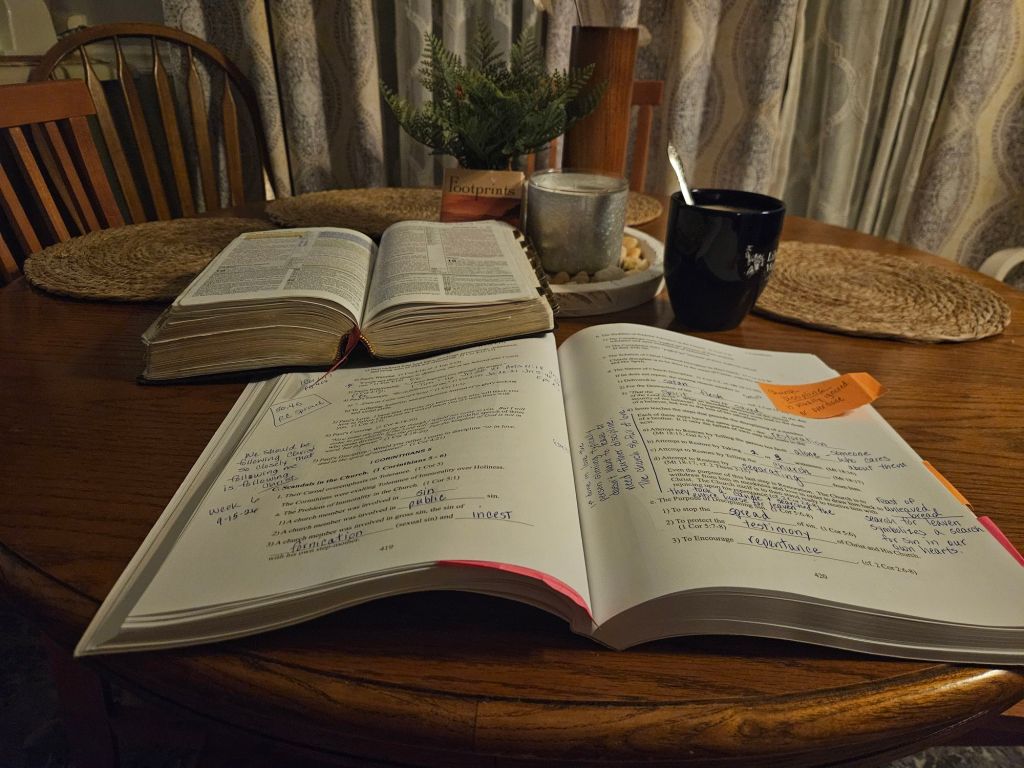
The dining room was quiet, holding that early-morning stillness where the light just begins to color the edges of the window. On the table sat my opened Bible, a stack of notes from last night’s Faith Bible Institute class, and a fresh cup of coffee going lukewarm in my hands.
My heart felt bruised, raw, and entirely spent.
Just days ago, I had stepped up to teach Sunday School, opening the Word with a simple desire to offer comfort and clarity. The lesson had been about relational noise—how easily our perception tricks us into fighting phantom battles, how human nature complicates what God made simple, and how Christ-centered peace requires us to unclench our hands and step out of the chaos. I had prepared it with prayer and delivered it with a gentle heart.
Instead of peace, it ignited a storm.
Because the truth hit too close to home for a few people in the room, the reaction was immediate and sharp. A meeting followed after church—a room filled with raised defenses, rewritten histories, and deep-seated pride. I watched as church leadership maneuvered around the tension, protecting status, active involvement, and financial contributions rather than following the clear, humble blueprint of Matthew 18.
Instead of bringing two sisters together to speak the truth in love and restore peace—which was supposedly the intent of the meeting—human policy took over. I sat in that room listening to zero apologies from anyone for their own actions. Instead, the finger was pointed directly at me, accusing me of spreading rumors, when I hadn’t said a single word to anyone in the church. The resolution offered was to quiet the victim, instruct the opposing party to ‘lay low,’ and ask me to step down from teaching.
We had tried to call. We had tried to text. We were met with total silence, covered by the repeated defense that the pastor had advised her to lay low and not respond. While the pastor later apologized for giving that counsel, the core issue remained: human advice does not override divine instruction. If a leader told you to stop reading your Bible or stop attending church, would you obey? A mature walk in Christ means knowing when advice violates the basic call to biblical reconciliation. Hiding behind bad counsel was simply a convenient shield for an unyielding heart
I knew in that moment there was no winning an argument against a wall of self-defense and institutional convenience. So, I took a deep breath, swallowed the lump in my throat, and offered a verbal apology to lower the heat in the room. I gave them head forgiveness—an act of the will, a quiet decision of restraint to keep the peace, protect the room, and keep the fire from spreading.
Standing in my quiet kitchen days later, I realized just how vast the ocean is between head forgiveness and heart forgiveness.
Head forgiveness is immediate. It’s an act of obedience that locks the door so bitterness can’t walk in. It says, I will not retaliate. I will keep my speech gracious. I will step back. It is what allowed me to walk out of that meeting with my dignity intact, even when my heart was breaking under the weight of an unfair consequence.
Heart forgiveness, though—heart forgiveness is a slow, quiet journey. It’s the deep emotional work that can’t be rushed, performed for a committee, or forced by a vote. Heart forgiveness is what happens in the days after, when the replay of those harsh words tries to run through your mind, and you have to consciously lay the burden back down at the feet of Jesus all over again.
It is a painful realization when you come face-to-face with the fact that some people simply cannot see their own wrongs.
For them, the entire narrative revolves around their own feelings, their defense mechanisms, and their perceived status. When self-worth is wrapped up in being right, even the gentlest mirror is viewed as an attack. They don’t ask, “Did I cause harm?”—they only ask, “How can I protect my comfort?” Watching someone rewrite history, recount their own resume, and demand empathy while offering none is a masterclass in the blinding power of human pride.
For a long time, I thought if I could just explain things a little clearer, or show enough grace, the light would turn on. But you cannot make a blind person see.
Recognizing that truth brings a quiet, unexpected liberty. It frees you from the exhausting loop of replaying conversations and wondering what you could have done differently. The issue wasn’t your delivery; it was their inability to look inward.
Every instinct in me wanted to defend myself. I wanted to pack up my things, walk out the front doors of that church, and never look back. I wanted to write my truth for everyone to see, to ensure people understood the hurt and the unfairness of how it was handled.
But then I thought of my Tuesday night Faith Bible Institute class. I thought of the 17 faithful souls who gather in that room every week, eager to study God’s Word, looking to me to host and protect that space. Relocating that class a year ago had simply been a practical decision born out of a lack of growth, not conflict—it was a healthy step forward. But subjecting these students to another relocation now, over a storm they didn’t create, was a weight I refused to place on their shoulders.
I realized that my silence wasn’t weakness or surrender to unfair treatment. My public quietness was a wall I was building to protect a flock God had entrusted to my care. It was the high road of a shepherd—choosing to absorb the bruise so the ministry could stand unblemished.
I no longer need their acknowledgment to validate my hurt, nor do I need their apology to walk in freedom. Offering head forgiveness keeps bitterness out of my heart, but accepting their blindness is what allows me to finally stop expecting a harvest from barren soil. I can pray for them from a healthy distance, guard the calling God has given me, and rest in the quiet assurance that truth doesn’t require their vote to remain the truth.
As I closed my journal and took a sip of coffee, the quiet settled back into the room. I don’t have all the answers for how the coming weeks will feel, and my heart still carries an ache that needs time to heal. But I know this: God sees what happens in the quiet. He knows the difference between staged harmony and genuine peace.
I may have had to step down from one podium, but I haven’t lost my footing. I can bow my head, unclench my hands, and trust that the God of all grace will finish the slow, gentle work of healing my heart—one quiet morning at a time.
 Finding God in the Little Things