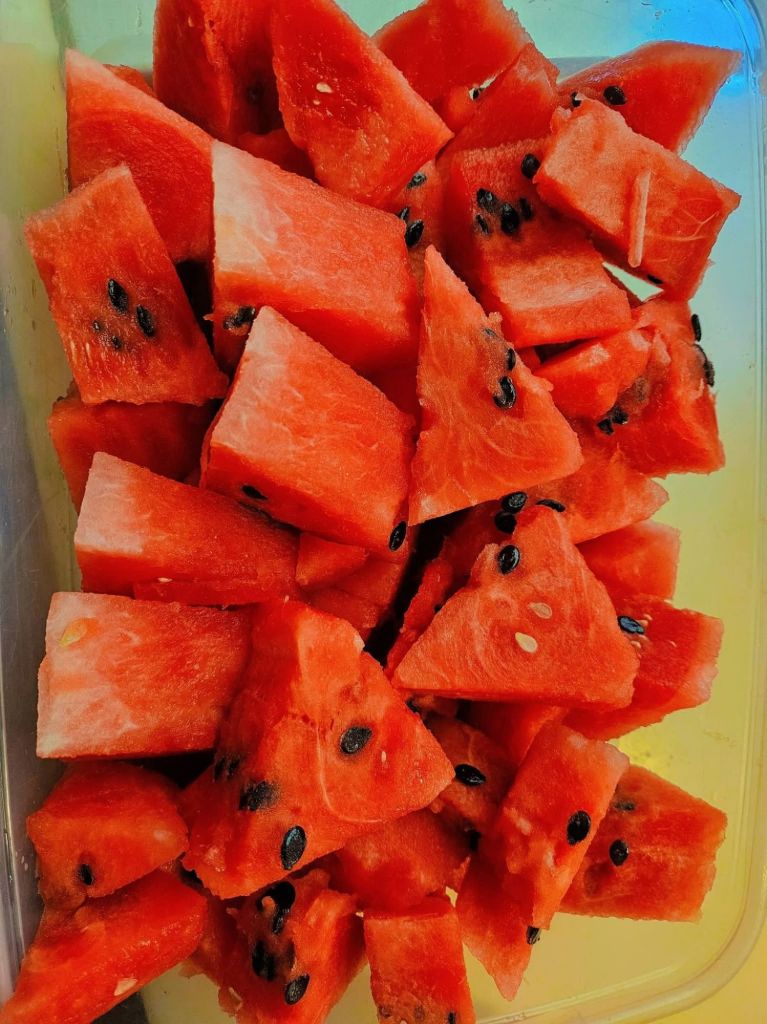
It’s no secret that I’ve eaten a lot of watermelon over the years. Anyone who has been around my kitchen for five minutes knows it’s pretty much a staple. Most of the time, I get lucky. I look for that dull green skin, find the creamy yellow spot where it rested against the earth, give it a good knuckle-tap, and bring home a winner.
I take it to the counter, cube it up, and enjoy that crisp, sweet crimson center. Simple and refreshing.
Today, though, I didn’t get so lucky.
Looking at the container sitting on my counter, you’d swear I pulled a prize-winner off the shelf. The pieces are a deep, vibrant red, dotted with black seeds, looking every bit like pure summer. But when I took that first bite, the middle was mealy, carrying that faint, strange edge of pesticides—a lingering hint of soil pushed too hard and forced to yield too fast.
It always catches me off guard. How does something with a peel that thick still absorb all that bitterness from the outside world?
I stood there in the quiet of the kitchen, looking at that clear plastic container and shaking my head a little. A bad melon is a mild annoyance, but I’m far too stubborn—and far too frugal—to throw it out. I’ll freeze it for smoothies or squeeze a little fresh lime over the top to mask the flavor. We adapt. We don’t waste what can still be used.
Standing by the sink, it struck me how much that container of watermelon looks like the rest of us.
We all walk around wrapped in our own thick rinds, doing our best to present a polished, sturdy exterior to the world. But everyone we cross paths with—at the grocery store, down the street, or across our own kitchen tables—is in a completely different place in their spiritual walk.
Some people carry a natural sweetness. Their fruit is good—poured out freely in kindness, patience, and grace that refreshes everyone around them. Other times, we meet people whose fruit is a little soft, or bitter around the edges. It’s easy to feel disappointed when what’s on the inside doesn’t match the bright exterior.
But the truth is, sometimes it isn’t even about a long, hard season. Sometimes people are just plain tired. Sometimes we’re hurting, or sick, or running on empty, and the pressure of simple daily life builds up until the things we’ve been trying so hard to hold inside just slip right out. We make mistakes. We have bad days.
When I’m having one of those days, I just close my eyes and say, “Lord, please help me.” And He always does.
I have to remind myself that my own fruit hasn’t always been sweet, either. I’ve had plenty of moments where weariness got the best of me and my own defenses crumbled. Haven’t we all?
The comfort is knowing the Vine Dresser doesn’t toss us aside when a season’s yield isn’t quite right. He doesn’t give up on the vine. He keeps tending the soil, trimming away the dry spots, and pouring His light into the dark places until the heart grows sweet again.
Now, when I slice into a melon that isn’t quite what I hoped for, it serves as a quiet reminder. It prompts me to offer a little more grace to the people I meet—remembering how much patience it took to bring sweetness to my own heart, and how much time we all need under the Son/sun.